
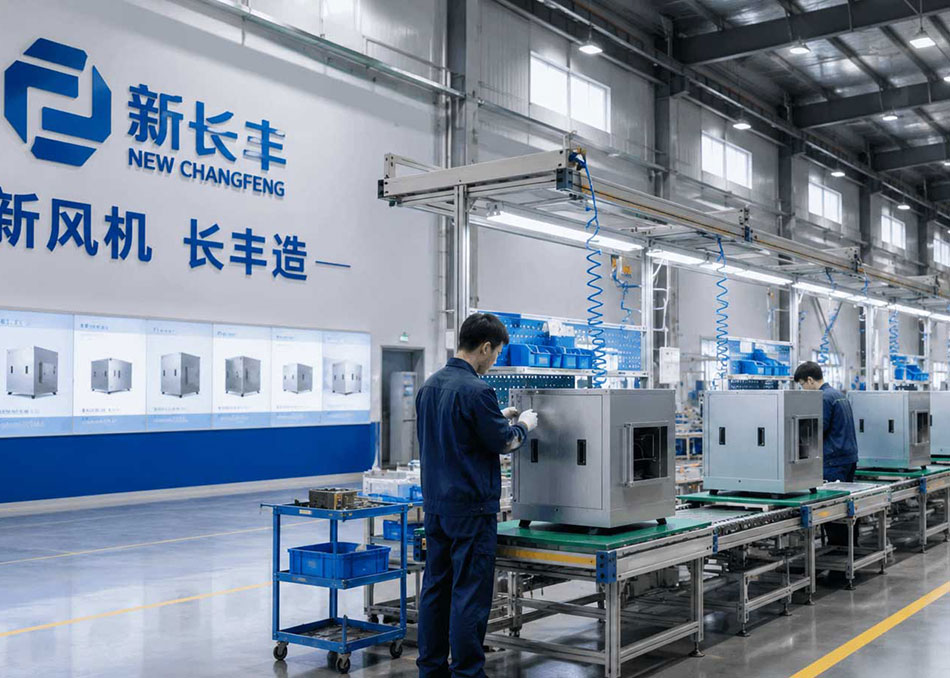
In Shenzhen, the reliable operation of ventilation systems in factories, commercial kitchens, and large warehouses depends on one critical component: the fan. Among the various fan types available, the multi-wing centrifugal fan stands out for its compact structure, high airflow, and relatively low noise levels. It is frequently used as supporting equipment in ducted ventilation systems, especially for the essential function of supply air and make-up air. However, many procurement professionals focus solely on airflow volume, overlooking critical factors such as system resistance, installation space, and operating efficiency. This oversight often leads to undersized or mismatched equipment, resulting in insufficient airflow, excessive noise, or elevated energy consumption. So, how should you select a multi-wing centrifugal fan for ventilation system integration in Shenzhen? This article outlines the key selection criteria based on real-world application scenarios.
Understanding the Role of Multi-Wing Centrifugal Fans in Ventilation Systems
The multi-wing centrifugal fan is a subtype of centrifugal fan characterized by a rotor with numerous forward-curved blades. These blades are wide and shallow, allowing the fan to generate relatively high static pressure at lower rotational speeds while maintaining a compact footprint. In ventilation system integration, multi-wing centrifugal fans are typically used as supply-air or make-up-air devices. For instance, they work in tandem with commercial kitchen exhaust systems to introduce fresh outdoor air, helping to maintain proper negative pressure balance within the space. They are also used in factory workshops to deliver filtered or cooled outdoor air indoors, improving overall air quality.
It is important to note that multi-wing centrifugal fans are not universal exhaust fans. For exhaust ducts carrying high concentrations of grease or requiring long-distance transport, backward-curved centrifugal fans or dedicated smoke exhaust fans are generally more appropriate. Therefore, the selection process must begin with a clear definition of the fan's duty—whether it is for supply air, make-up air, or general ventilation—before evaluating specific performance parameters.
Key Selection Criteria for Shenzhen Applications
1. System Resistance and Static Pressure
One of the most common mistakes is selecting a fan based on airflow alone. Every duct system imposes resistance, including friction losses from duct length and fittings, as well as dynamic losses from filters, dampers, and diffusers. The fan must overcome this total system resistance to deliver the required airflow. In Shenzhen's dense urban environment, duct runs can be complex, and underestimated resistance often results in fans operating outside their optimal range. Always calculate the total system static pressure using industry-standard methods, and select a fan whose performance curve provides sufficient pressure at the required airflow point.
2. Available Installation Space
Shenzhen facilities often face space constraints, especially in retrofit projects within commercial buildings or existing factories. Multi-wing centrifugal fans are available in various configurations—direct-drive, belt-driven, and with different inlet/outlet orientations. Before choosing, measure the available space carefully, considering access for maintenance and filter replacement. Compact direct-drive models may be ideal for tight spaces, while belt-driven units offer more flexibility for adjusting fan speed to match changing system requirements.
3. Energy Efficiency and Operating Costs
With rising electricity costs and increasing environmental regulations, energy efficiency is a major consideration. Multi-wing centrifugal fans are generally efficient for low-to-medium pressure applications, but operating point selection is crucial. A fan running far from its best-efficiency point wastes energy and accelerates wear. Look for fans that comply with relevant energy efficiency standards, and consider variable speed drives if the system demand fluctuates throughout the day. In Shenzhen's climate, where cooling loads are significant, integrating energy-efficient fans with the overall HVAC strategy can yield substantial long-term savings.
4. Noise and Vibration
Noise levels are a critical factor in commercial kitchens, office-adjacent facilities, and residential neighborhoods. While multi-wing fans are inherently quieter than some alternatives at comparable duties, noise is strongly influenced by installation quality. Use flexible connections at the fan inlet and outlet to prevent vibration transmission through the ductwork. Ensure the fan base is adequately isolated, and consider acoustical lining in ducts where noise is a concern. Always review the fan's noise data and compare it against local regulations and project specifications.
5. Material Selection and Environmental Resistance
Shenzhen's coastal environment presents unique challenges, including high humidity and salt-laden air that can accelerate corrosion. For outdoor installations or applications where the fan handles humid air, select fans with appropriate corrosion-resistant coatings or materials, such as galvanized steel or stainless steel. In commercial kitchen applications, the fan must handle air that may contain grease particulates, even in make-up air duties. Ensure that materials and finishes are compatible with the application environment to maximize service life.
Common Configuration and Sizing Mistakes to Avoid
- Oversizing the fan: Selecting a fan with a much higher capacity than needed leads to unnecessary energy consumption and noise. It also creates control challenges when trying to match actual demand.
- Ignoring inlet conditions: Poor inlet duct design, such as sharp elbows close to the fan inlet, can cause uneven airflow distribution and reduce fan performance by up to 20%. Follow manufacturer recommendations for inlet straight duct runs.
- Neglecting altitude and temperature corrections: Air density affects fan performance. While Shenzhen is at low altitude, high summer temperatures reduce air density slightly. If the fan is specified at standard conditions, verify that it will still deliver the required mass flow at elevated temperatures.
- Forgetting about future flexibility: If system expansion is anticipated, consider selecting a fan that can be upgraded with a larger motor or variable speed drive without complete replacement.
Work with Experienced Suppliers for System Integration
Selecting the right multi-wing centrifugal fan is not just about picking a model from a catalog. The most successful projects involve collaboration between the system designer, the installer, and the fan manufacturer. Experienced suppliers can assist with fan selection based on detailed system analysis, provide performance data from certified tests, and offer guidance on installation best practices. When sourcing fans in Shenzhen, choose a supplier with a proven track record in industrial and commercial ventilation, and one who can provide after-sales support, spare parts, and maintenance services.
By taking a systematic approach—understanding the fan's role, calculating system resistance, considering space and environmental constraints, and prioritizing energy efficiency—you can ensure that your ventilation system operates reliably and cost-effectively for years to come.
FAQ
Q: What is the main difference between a multi-wing centrifugal fan and a backward-curved centrifugal fan?
A: Multi-wing fans have many forward-curved blades, which allow them to generate moderate pressure with a compact size and lower noise at equivalent duties. Backward-curved fans have fewer blades and are more efficient at higher pressures, making them better suited for long duct runs or high-resistance systems. For supply air and make-up air duties in typical ventilation systems, multi-wing fans are often the practical choice.
Q: Can a multi-wing centrifugal fan be used for kitchen exhaust?
A: For kitchen exhaust ducts carrying high grease loads, dedicated exhaust fans or backward-curved centrifugal fans are generally recommended. Multi-wing fans are best used for the make-up air side of the system—supplying fresh air to balance the air removed by the exhaust fan. Using a multi-wing fan for heavy grease exhaust may lead to blade fouling and reduced performance.
Q: How do I know what static pressure my system requires?
A: Static pressure is determined by the total resistance of the duct system, including straight duct sections, elbows, transitions, filters, dampers, and terminal devices. A duct design calculation, typically performed by a mechanical engineer or experienced ventilation contractor, will sum these losses to determine the total static pressure at the design airflow. Fan curves are then consulted to select a fan that meets both airflow and pressure requirements.
Q: Is it better to use a direct-drive or belt-driven multi-wing fan?
A: Direct-drive fans have no belts to maintain, are more compact, and offer precise speed matching to the motor. Belt-driven fans allow for speed adjustments by changing pulley sizes, offering flexibility if system conditions change. The choice depends on your application's need for adjustability and maintenance preferences.
Q: What maintenance does a multi-wing centrifugal fan require?
A: Regular maintenance includes inspecting and cleaning the blades to prevent dust buildup, checking bearing lubrication, verifying belt tension (for belt-driven models), and inspecting electrical connections. In coastal areas like Shenzhen, periodic checks for corrosion are also recommended. Following the manufacturer's maintenance schedule will extend fan life and maintain performance.
Selecting the right multi-wing centrifugal fan for your Shenzhen ventilation project requires a balance of technical knowledge and practical experience. By focusing on the key criteria outlined above and partnering with a reputable supplier, you can ensure a well-integrated system that meets your airflow, noise, and efficiency goals.