
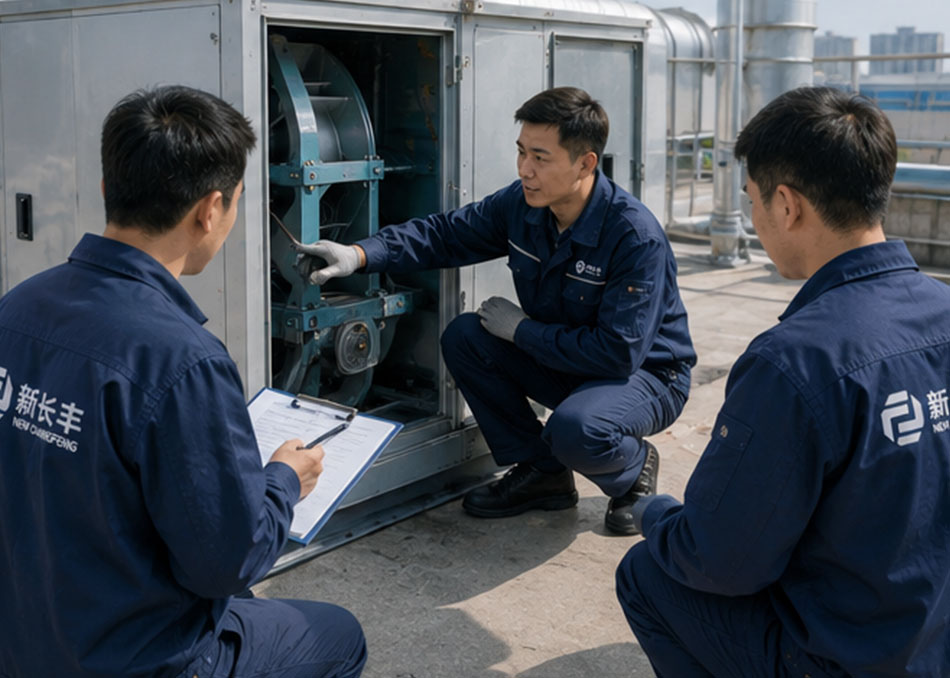
Commercial kitchens are among the most demanding ventilation environments in any building. When a kitchen exhaust system runs at full capacity, it continuously removes large volumes of air. If make-up air cannot keep pace, the kitchen develops a strong negative pressure: burner flames get pulled sideways, cooking fumes escape into the dining area, doors become difficult to open, and the exhaust ductwork itself can begin to surge or vibrate. The water-cooled fresh air unit is designed specifically to resolve this conflict — it delivers outdoor air into the kitchen while simultaneously lowering the supply air temperature through evaporative cooling or surface heat exchange, so make-up air is no longer simply hot air. Yet many kitchens install the unit and then neglect it: filters become clogged with grease, water tanks scale and develop odors, and airflow quietly declines year after year. This article examines water-cooled fresh air unit maintenance from the perspective of kitchen negative pressure management.
Why Make-Up Air and Negative Pressure Balance Matter in Commercial Kitchens
A kitchen exhaust system continuously extracts air from the space. According to the principle of flow continuity, the volume of air exhausted must be matched by an equal volume of make-up air; otherwise, indoor static pressure drops and negative pressure forms. The consequences are immediate and practical. First, burners operate with insufficient combustion air: gas flames turn yellow, heating power drops, fuel is wasted, and carbon monoxide risk increases. Second, grease capture efficiency falls — fumes escape from the edges of the exhaust hood and drift into the dining room. Third, doors become hard to open, affecting staff movement and, more critically, emergency evacuation.
From a codes and standards perspective, GB 51251 (Technical Standard for Smoke Control and Exhaust Systems in Buildings) and related commercial kitchen ventilation design requirements set clear constraints on make-up air volume, make-up air path, and supply air temperature. A sound engineering approach is to keep make-up air volume slightly lower than exhaust volume, maintaining a controlled negative pressure rather than an extreme one. This balance prevents fumes from migrating into adjacent spaces while keeping combustion appliances and hood capture performance within acceptable ranges.
The water-cooled fresh air unit supports this balance by providing a dedicated, conditioned make-up air stream. Unlike simply opening a door or relying on uncontrolled infiltration, it delivers filtered outdoor air at a temperature closer to indoor conditions, reducing the thermal discomfort that often leads operators to shut down make-up air systems altogether.
How a Water-Cooled Fresh Air Unit Works in a Kitchen Environment
A water-cooled fresh air unit combines ventilation and cooling in a single package. Outdoor air is drawn through filters and then passes through a cooling section — either an evaporative cooling pad or a surface heat exchanger connected to a water circuit. The cooled air is then supplied to the kitchen, typically near the cooking line or distributed to reduce stagnant zones. Because the unit cools the air as it supplies it, the kitchen does not experience the "blowing hot air" problem that occurs with simple fan-only make-up systems.
In a commercial kitchen, this cooling effect is particularly valuable. Cooking lines generate intense radiant and convective heat. Adding unconditioned outdoor air — which may be well above 30°C in summer — can make the kitchen unbearable and undermine staff willingness to keep the make-up system running. By lowering supply air temperature, the water-cooled fresh air unit improves working conditions while still fulfilling its primary role: replacing exhausted air and stabilizing kitchen pressure.
It is important to note that the unit is not a substitute for the exhaust hood or the exhaust fan. It works in concert with them. The exhaust system captures and removes fumes; the water-cooled fresh air unit supplies replacement air. If either side is undersized, poorly maintained, or incorrectly balanced, the entire kitchen ventilation system underperforms.
Key Maintenance Points for Water-Cooled Fresh Air Units
Maintenance is where most kitchen ventilation systems fail. A water-cooled fresh air unit has several components that degrade in the grease-laden, humid kitchen environment. Regular attention to these areas preserves airflow, cooling performance, and hygiene.
- Filters: Grease and dust accumulate quickly. Clogged filters reduce airflow and increase fan load. Clean or replace according to the manufacturer's schedule — typically more frequently in heavy-production kitchens.
- Cooling pad or heat exchanger: Scale, biofilm, and grease can coat heat exchange surfaces, reducing cooling efficiency. Inspect and clean regularly. For evaporative pads, check for channeling, collapse, or algae growth.
- Water tank and circulation system: Stagnant water scales, odors, and becomes a hygiene risk. Drain, clean, and refill on a set schedule. Check pumps, float valves, and distribution headers for proper operation.
- Fan and motor: Grease buildup on impellers causes imbalance, vibration, and noise. Inspect belts, bearings, and mounting. Lubricate according to the manufacturer's instructions.
- Ductwork and supply outlets: Check for grease accumulation, loose connections, and blocked or misdirected diffusers. Ensure supply air reaches the intended zones without short-circuiting to the exhaust hood.
- Controls and sensors: Verify that any pressure, temperature, or airflow sensors are clean and functioning. Recalibrate if readings drift.
- Drainage: Condensate and overflow lines must flow freely. Blocked drains can cause water carryover, corrosion, and microbial growth.
Beyond component-level maintenance, the interaction between make-up air and exhaust must be checked periodically. Airflow balancing should be verified after any change to the kitchen layout, exhaust hood configuration, or cooking equipment. A system that was balanced at commissioning can drift out of balance as filters load, belts slip, or dampers move.
Common Problems and Practical Solutions
Several problems recur in commercial kitchens that use water-cooled fresh air units. Recognizing them early prevents costly downtime and improves kitchen conditions.
Reduced airflow over time. This is usually caused by clogged filters, dirty cooling pads, or grease-coated fan blades. The fix is straightforward: establish a cleaning schedule and document it. If airflow remains low after cleaning, check ductwork for blockages and verify damper positions.
Water carryover or excessive humidity. Evaporative cooling units can carry water droplets into the supply air if the pad is over-saturated, the airflow is too high, or the eliminator is missing or damaged. Inspect the pad, water distribution, and eliminator. Ensure the unit is not operating beyond its design airflow range.
Odors from the unit. Stagnant water in the tank or biological growth on cooling pads is the usual cause. Drain and disinfect the water system, replace degraded pads, and ensure the unit dries out during off cycles if the design allows.
Noise and vibration. Grease-imbalanced fans, worn bearings, or loose mounting are common culprits. Clean the impeller, inspect bearings, and tighten mounts. Address vibration promptly — it accelerates wear and can damage duct connections.
Kitchen still under negative pressure. If the kitchen remains under excessive negative pressure despite the make-up air unit running, the unit may be undersized, the supply path may be restricted, or the exhaust may have been increased without adjusting make-up air. A professional airflow balance test is the appropriate next step.
FAQ
Q: How often should a water-cooled fresh air unit be maintained in a commercial kitchen?
A: Maintenance frequency depends on cooking volume, grease loading, and water quality. In heavy-production kitchens, filters and cooling pads may need attention weekly or biweekly, with a more thorough inspection monthly. Water tanks should be drained and cleaned on a regular schedule to prevent scaling and odors. Always follow the manufacturer's recommendations and local hygiene requirements.
Q: Can a water-cooled fresh air unit eliminate kitchen negative pressure on its own?
A: No. It is one part of a balanced ventilation system. The exhaust hood and exhaust fan remove air; the make-up air unit supplies replacement air. Proper design, sizing, and balancing of both sides are required. The unit helps maintain a controlled negative pressure when it is correctly sized and maintained, but it cannot compensate for an undersized or poorly designed exhaust system.
Q: What are the signs that a water-cooled fresh air unit needs immediate attention?
A: Warning signs include visibly dirty filters, water leaks or carryover, unpleasant odors from supply air, unusual noise or vibration, reduced airflow at supply outlets, and doors that become difficult to open. Any of these indicates that the unit or the overall ventilation balance needs inspection.
Q: Does cooling the make-up air really matter in a kitchen?
A: Yes. In hot climates or during summer months, supplying unconditioned outdoor air can raise kitchen temperatures significantly, making the space uncomfortable and reducing staff compliance with ventilation procedures. Cooling the make-up air improves working conditions and helps keep the ventilation system operating as intended.
Conclusion
Water-cooled fresh air units play a critical role in commercial kitchen ventilation by supplying cooled make-up air and helping maintain a controlled negative pressure. But they only perform reliably when they are properly maintained. Grease, scale, and neglect degrade performance quietly, undermining both kitchen comfort and fume capture. A practical maintenance routine — covering filters, cooling surfaces, water systems, fans, and controls — preserves airflow and cooling capacity over the long term.
For kitchen operators and facility managers seeking dependable ventilation and cooling equipment, XCFFJ manufactures a range of industrial and commercial solutions, including water-cooled fresh air units, cabinet centrifugal fans, negative pressure fans, and kitchen exhaust purifiers. To discuss make-up air and negative pressure control for your kitchen project, visit www.xcffj.com.