
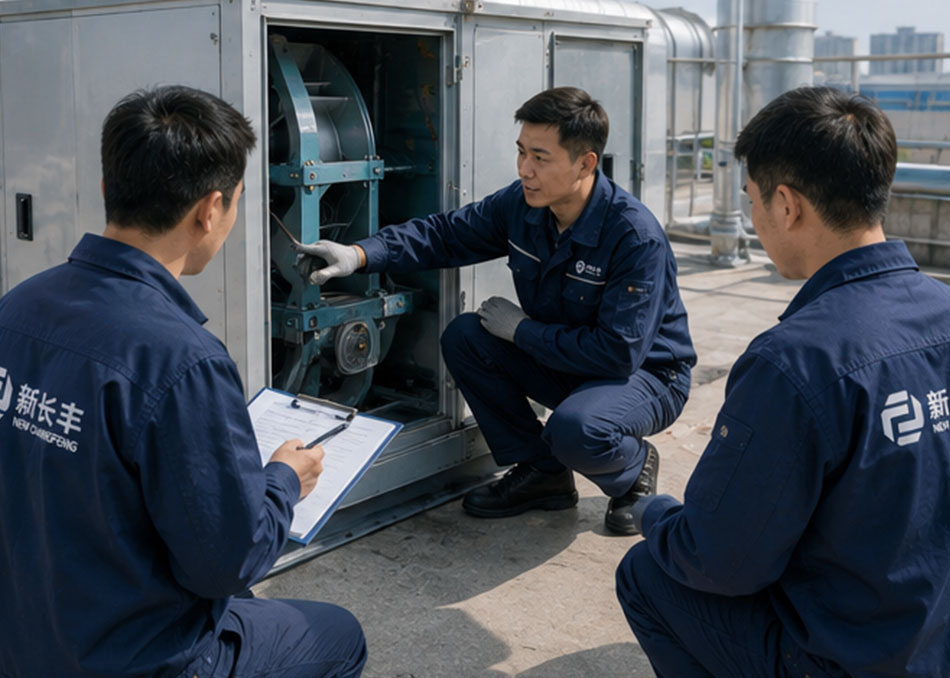
Internet cafés sit at the extreme end of indoor heat density. Dozens or hundreds of gaming rigs and monitors run continuously, seats are packed close together, and doors and windows stay shut for security and noise control. The result is a space where sensible heat load far exceeds what a typical retail interior was designed for. In many street-front locations the floor plate is deep, openable windows are few, and there is no clear exhaust path — so a few wall-mounted split air conditioners can lower temperature but cannot exchange air. CO₂ climbs, smoke and odour linger, and customers start feeling stuffy and headachy within half an hour of logging in. Repeat visits suffer.
From a ventilation engineering standpoint, an internet café has two jobs to do: remove sensible heat generated by equipment and occupants, and supply fresh outdoor air to dilute CO₂, smoke and odour. The conventional fix — air conditioning plus exhaust fans — creates a problem of its own. Exhaust fans pull air out without bringing any in, driving the space into negative pressure. Air then leaks back through door gaps, bathroom exhausts and service shafts, dragging odour and humidity with it. A water-cooled fresh air unit addresses both jobs in a single machine: it delivers filtered outdoor air while evaporative cooling lowers the supply air temperature, so ventilation does not come at the cost of added heat load.
Why Internet Cafés Need a Different Airflow Strategy from Commercial Kitchens
It is worth separating two ventilation logics that are often confused. In a commercial kitchen, the design principle is exhaust-led: the hood and exhaust fan establish negative pressure so that grease, smoke and odour cannot escape into the dining area. Supply air is sized to match what is extracted. An internet café works the other way around. The priority is supply-led, with the space held at slight positive pressure. Fresh air is pushed in deliberately, and stale air is displaced out through planned relief paths — corridor transfer grilles, ceiling plenums, dedicated relief openings.
This distinction drives equipment selection. A unit chosen for a kitchen exhaust application will be sized around extraction volume and capture velocity. A unit chosen for an internet café must be sized around occupancy, equipment heat load and the required outdoor air rate per person, then balanced against a defined relief path. Getting this wrong is the most common reason a fresh air installation underperforms: the machine is fine, but the airflow organisation is not.
- Supply-led, slight positive pressure — prevents backdraught from bathrooms, kitchens and neighbouring units.
- Defined relief path — stale air needs somewhere to go; without it, positive pressure simply leaks through the façade.
- Filtration matters — street-front cafés draw in dust and vehicle exhaust; filter grade directly affects perceived air quality.
- Noise is a design constraint — gaming spaces are quiet; supply terminals and unit placement must be chosen accordingly.
How a Water-Cooled Fresh Air Unit Works
The core principle is evaporative cooling combined with mechanical ventilation. Outdoor air is drawn through a filter, then passed across a wetted cooling medium — typically a rigid cellulose or polymer evaporative pad with a water distribution system above it. As air moves through the wetted media, a portion of the sensible heat is converted to latent heat through evaporation, so the delivered air is cooler than the outdoor air without a compressor or refrigerant circuit. A centrifugal or multi-wing fan then pushes the conditioned air through ductwork to the occupied zone.
Because the process is evaporative rather than refrigerative, performance depends on the ambient wet-bulb temperature. In hot, dry conditions the temperature drop across the pad is larger; in humid coastal conditions it is smaller. This is a physical characteristic of evaporative cooling, not a defect, and it should be reflected honestly in any design calculation. For internet cafés in most Chinese climate zones, the unit functions primarily as a ventilation and heat-removal device, with the cooling effect as a valuable secondary benefit — particularly useful during shoulder seasons when running full air conditioning is unnecessary.
The ventilation side is where the unit earns its place. By continuously introducing outdoor air at a controlled rate, it directly attacks the CO₂ accumulation and odour problems that air conditioning alone cannot touch. Combined with a properly designed relief path, the space stays at slight positive pressure, so smoke and bathroom odour do not migrate back into the gaming floor.
Design Considerations Before You Specify
Several factors determine whether an installation will meet expectations. Outdoor air rate should be calculated from occupancy and floor area, referencing the relevant ventilation design guidance for public entertainment premises rather than rules of thumb. Equipment heat load should be estimated from installed rig and monitor capacity, with diversity applied realistically. Fan performance should be verified against GB/T 1236 test data, and fan energy efficiency considered under GB 19761 so that running costs are predictable. Where the building has smoke control provisions, ductwork and penetrations must not compromise the smoke and heat exhaust strategy under GB 51251.
Duct layout deserves early attention. Long, convoluted runs raise static pressure and reduce delivered airflow, and every unnecessary bend costs energy. Supply terminals should be positioned to reach occupied zones without dumping air directly onto customers. Water supply and drainage for the evaporative pad need to be planned, along with a maintenance access route for pad cleaning and replacement — scale and dust accumulation reduce both cooling effectiveness and airflow over time.
Finally, consider how the fresh air unit interacts with the existing air conditioning. In many internet cafés the two systems run in parallel: the water-cooled fresh air unit handles ventilation and part of the sensible load, while the split systems trim the remaining temperature. Controls should be set so the systems do not fight each other, and so that fresh air operation continues even when cooling demand is low.
Practical Benefits for Operators
- Better perceived air quality — continuous outdoor air supply reduces CO₂ and odour, which customers notice immediately.
- Lower negative-pressure problems — slight positive pressure stops bathroom and corridor odour from being drawn in.
- Reduced cooling energy in dry conditions — evaporative cooling carries part of the sensible load without compressor operation.
- Single-machine simplicity — ventilation and cooling are combined, simplifying plant space and maintenance.
- Extended useful hours — the unit can run in shoulder seasons when air conditioning alone would be excessive.
FAQ
Q: Can a water-cooled fresh air unit replace air conditioning in an internet café?
A: Generally no. It is a ventilation device with evaporative cooling, and its temperature drop depends on ambient wet-bulb conditions. In most climates it reduces the sensible load and improves air quality, while air conditioning handles the remaining temperature control. The two work best as a combined strategy.
Q: Why is positive pressure preferred here rather than the negative pressure used in kitchens?
A: Kitchens use negative pressure to contain grease and smoke at the source. Internet cafés need the opposite: fresh air supplied in controlled quantities to displace CO₂ and odour, with stale air leaving through planned relief paths. Negative pressure in a gaming space draws in odour and humidity from adjacent areas.
Q: How much maintenance does the evaporative pad need?
A: Pads require periodic cleaning and eventual replacement, with frequency depending on local dust levels and water hardness. Scale buildup reduces cooling efficiency and raises resistance to airflow, so a scheduled inspection routine is essential to keep performance stable.
Q: What standards should be referenced when specifying the fan?
A: Fan airflow and pressure should be verified against GB/T 1236 test methods, and energy efficiency assessed under GB 19761. Where smoke control systems are present, ductwork must comply with GB 51251. For premises serving food, kitchen fume emission limits under GB 18483 apply to the cooking area, not the gaming floor.
Ventilation in high-density entertainment spaces is a design problem before it is an equipment problem. Once the airflow logic is right — supply-led, slight positive pressure, defined relief path — a water-cooled fresh air unit becomes a straightforward way to deliver both outdoor air and sensible cooling from one machine. XCFFJ manufactures water-cooled fresh air units and a full range of industrial and commercial ventilation equipment, and can advise on matching unit selection to your space, occupancy and climate.