
Internet cafes present a ventilation problem that ordinary commercial spaces rarely face: dozens of high-performance gaming rigs packed into a single room, occupants who stay for hours at a time, and doors and windows kept shut for air conditioning and noise control. In summer, heat rejected by the machines stacks on top of body heat, indoor temperatures climb quickly, and CO₂ and odors accumulate. Operators feel the result in complaints, shortened sessions, and a room that simply feels stuffy.
Split-system air conditioners are the usual first response, but they only recirculate and chill indoor air—they introduce no fresh air. Adding an exhaust fan alone creates a different set of problems: the room goes negative, door gaps whistle, odors from adjacent spaces are drawn back in, and cooled air is pulled out almost as fast as it is paid for. What the space actually needs is a system that supplies, cools, and balances air at the same time. Water-cooled fresh air units are a common answer, and this article explains how they work, how to select one, and how to avoid the pressure and make-up air mistakes that undermine otherwise sound installations.
Why Internet Cafes Struggle With Heat and Air Quality
An internet cafe is a high-density occupancy by design. Workstations are clustered to maximize seat count, each with a monitor, CPU, and often a dedicated GPU running near continuous load. Unlike an office, there is no natural break in the internal heat gain—the room is occupied from opening to closing, and the equipment never really idles.
At the same time, the building envelope works against ventilation. Doors and windows stay closed to keep conditioned air in and street noise out. Without a deliberate fresh air path, CO₂ rises steadily through the evening, odors from food and beverages linger, and the perceived air quality drops well before the temperature does. Guests notice this as drowsiness, headaches, or simply a room that "smells used."
- Internal heat gain from dense computer equipment plus occupants
- Sealed envelope with little or no mechanical fresh air
- Long occupant dwell times, so air quality problems compound
- Split AC units that cool but do not ventilate
- Exhaust-only fixes that create negative pressure and pull in odors
How a Water-Cooled Fresh Air Unit Works
A water-cooled fresh air unit is an evaporative cooling supply unit. Outdoor air passes through a wetted evaporative medium; as water evaporates it absorbs sensible heat from the airstream, so the supply air leaves cooler than the ambient air while a large volume of fresh outdoor air is delivered into the room. Because the unit draws from outside rather than recirculating room air, it addresses cooling and ventilation in a single pass.
The distinction from compressor-based cooling matters. There is no refrigerant circuit and no condensing unit; the cooling effect comes from the evaporation process itself. That generally means lower electrical demand for the delivered cooling, simpler maintenance, and a continuous supply of outdoor air rather than the closed-loop recirculation of a split system. The trade-off is that performance depends on the ambient wet-bulb condition, so the unit is best understood as a ventilation-and-cooling solution rather than a replacement for refrigerated AC in every climate.
In practice, the unit is ducted to deliver treated outdoor air to occupied zones, while the room's relief air is managed deliberately. Fan performance should be verified against GB/T 1236 (industrial fan performance testing), and fan energy efficiency assessed against GB 19761 so that the ventilation benefit is not offset by excessive fan power.
The Negative Pressure Trap: Kitchen Exhaust and Make-Up Air
Many internet cafes share a building with, or sit adjacent to, food service operations. Commercial kitchen exhaust hoods move large volumes of air out of the building, and if that air is not replaced, the entire floor goes negative. The symptoms are familiar: the cafe's doors are hard to open, odors from the kitchen or restrooms migrate into the gaming area, and exhaust performance at the hood itself degrades.
This is where the water-cooled fresh air unit earns its place in the design. By supplying outdoor air to the space, it provides make-up air that relieves the negative pressure created by kitchen exhaust, while simultaneously cooling and ventilating the gaming floor. The two functions reinforce each other: the kitchen hood keeps working at its rated capacity, and the cafe receives tempered fresh air instead of borrowed odors.
Kitchen exhaust design and fume emission should follow GB 18483 for fume concentration limits and GB 51251 where smoke and heat exhaust systems are involved. Pressure relationships between the kitchen, the cafe, and adjacent spaces should be planned as a system, not solved piecemeal with extra fans.
Selection and Installation Points That Actually Matter
Selecting a unit begins with a realistic fresh air requirement based on occupancy and floor area, not a guess at "enough." From there, the duct layout determines whether the unit can deliver that air where people actually sit. Long, undersized, or sharply bent duct runs waste static pressure and quietly reduce delivered airflow.
Installation details decide whether the design performs. The unit needs an accessible outdoor air intake away from exhaust discharges and kitchen fume outlets, a water supply and drain arrangement that supports the evaporative medium, and a service clearance that lets staff clean or replace the pad without dismantling ductwork. Controls should allow the unit to run independently of the AC system so ventilation continues when cooling demand is low.
- Size fresh air volume from occupancy and floor area, then confirm with duct pressure calculations
- Keep intake and exhaust terminations well separated to prevent cross-contamination
- Plan water supply, drainage, and pad access before finalizing duct routes
- Provide relief air paths so the space does not over-pressurize
- Commission airflow after installation rather than trusting nameplate values
Where XCFFJ Fits
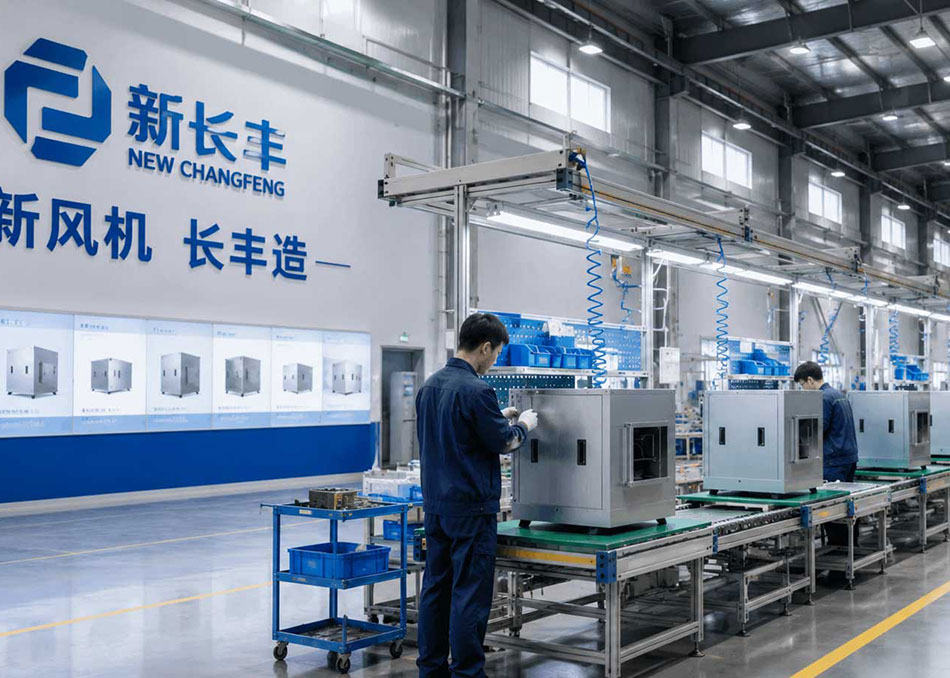
XCFFJ (Shenzhen Xinchangfeng Dust Removal & Cooling Equipment Co., Ltd.) manufactures industrial and commercial ventilation and cooling equipment, including water-cooled fresh air units, cabinet centrifugal fans, multi-wing centrifugal fans, negative pressure fans, kitchen exhaust purifiers, evaporative air coolers, and KTJ silent fresh air cabinets. For internet cafe projects, the relevant capability is the ability to combine a fresh air supply unit with matched fans and exhaust purification so that supply, relief, and kitchen exhaust are engineered as one pressure-balanced system.
Because the company also produces the fans and purification equipment on either side of the fresh air unit, projects can be specified with consistent performance testing and energy efficiency references rather than mixed components from unrelated suppliers. For operators renovating an existing cafe, the practical starting point is a site survey of the current pressure balance, duct routes, and kitchen exhaust interaction.
FAQ
Q: Can a water-cooled fresh air unit replace the split air conditioners in an internet cafe?
A: Not necessarily. The unit supplies cooled outdoor air and solves ventilation, but its cooling effect depends on ambient wet-bulb conditions. In many projects it works alongside existing AC, reducing the cooling load and maintaining air quality while the AC handles peak sensible load.
Q: Why does adding an exhaust fan sometimes make the smell worse?
A: An exhaust fan without a matching make-up air path drives the space negative. Air then enters through door gaps, restrooms, or kitchen areas, carrying odors with it. Balancing exhaust with deliberate fresh air supply is what prevents this.
Q: How does the unit interact with a commercial kitchen hood in the same building?
A: The fresh air unit provides make-up air that offsets the air removed by the hood. This keeps the kitchen exhaust working at its intended capacity and prevents kitchen odors from being drawn into the gaming area. The pressure relationship should be designed and commissioned as a single system.
Q: What maintenance does an evaporative fresh air unit need?
A: The evaporative medium needs periodic cleaning or replacement, and the water supply and drain should be checked for scale and standing water. Access clearance planned at installation is what makes this routine rather than disruptive.
Summary
Internet cafe ventilation fails when cooling and fresh air are treated as separate problems. A water-cooled fresh air unit addresses both by supplying cooled outdoor air continuously, and when it is coordinated with kitchen exhaust and relief air paths, it also resolves the negative pressure that pulls odors into the room. The design work—sizing, duct routing, pressure balance, and commissioning—matters as much as the equipment itself. To discuss a specific site, contact XCFFJ at www.xcffj.com.