
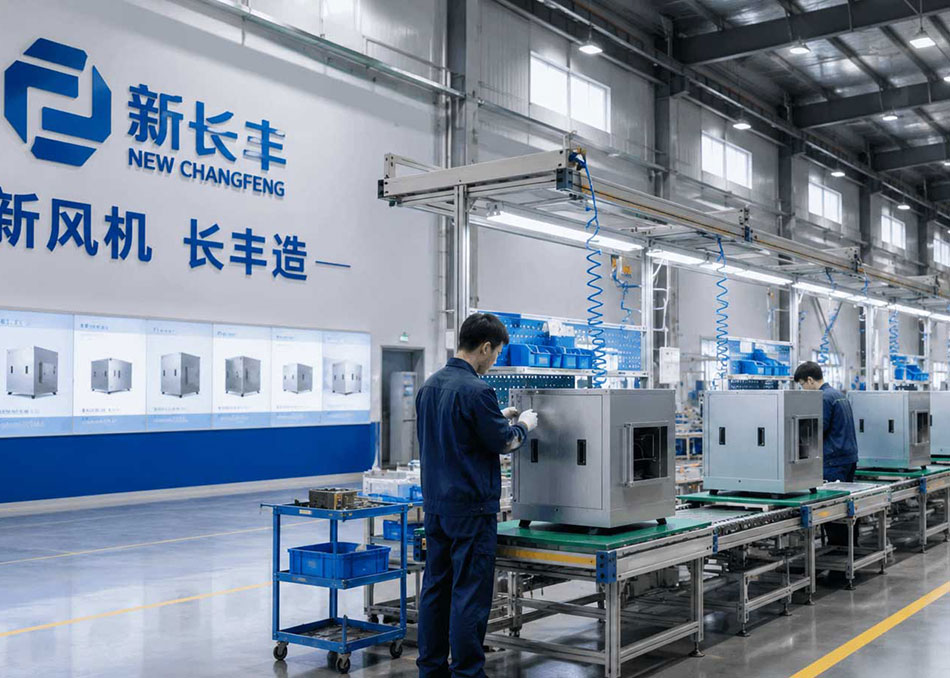
School canteens present a tougher exhaust challenge than most commercial kitchens. Meals are served in tight, high-intensity windows; dozens of cooking stations may fire up simultaneously; and the kitchen building often sits right next to classrooms or dormitories. When the exhaust fan is undersized or poorly matched to the system, the symptoms are predictable: weak capture at the hood, smoke rolling out at the duct end, a sweltering prep area, and noise complaints from nearby buildings. The DT cabinet centrifugal fan—a compact, belt-driven centrifugal unit housed in a cabinet—has become a common choice for school canteen exhaust purification because it balances pressure capability, footprint, and compatibility with fume purification equipment. This article walks through the selection logic, system matching, and installation practices that keep a canteen exhaust system working reliably.
Understand the Operating Conditions Before Choosing a Fan
A canteen exhaust system is not a single equipment decision. It is a chain: cooking stations → exhaust hood → ductwork → fume purifier → fan → discharge point. If the fan is too small, the hood loses capture velocity and grease-laden air escapes into the kitchen. If it is oversized, you pay for it in noise, energy consumption, and duct vibration. GB 18483, the Chinese emission standard for cooking fume, requires that oily fumes be purified before discharge—so the fan must not only move air, but also overcome the resistance of the purification stage without collapsing in airflow.
School canteens have three distinctive traits:
- Concentrated operating periods: Breakfast, lunch, and dinner run at high intensity for short durations. The fan must hold steady airflow during those peaks, not just perform on a test bench.
- High simultaneous use: Multiple woks, steamers, and griddles operate at once, so the total exhaust volume is high and continuous.
- Strict environmental constraints: Because canteens are close to teaching or residential buildings, noise, odor, and visible smoke carry real consequences.
Before selecting any model, map the actual cooking equipment, hood dimensions, duct route, and purifier type. A fan chosen without this map is a guess.
Why the DT Cabinet Centrifugal Fan Fits Canteen Exhaust
The DT series belongs to the cabinet centrifugal fan family. Its impeller draws air axially and discharges it radially, which gives it a relatively flat pressure–volume curve compared with axial fans. In practical terms, that means it can handle the resistance of long ducts, elbows, and a fume purifier without losing as much airflow. The cabinet enclosure also reduces noise radiation and protects the motor from grease and moisture—both common in canteen environments.
For school canteens, three features matter most:
- Pressure adaptability: Centrifugal impellers maintain airflow better as system resistance rises, which is critical when a purifier and long duct run are in the path.
- Compact integration: The cabinet form allows the fan to sit indoors or on a roof slab without a large dedicated plant room, and it pairs easily with electrostatic or UV purifiers.
- Noise control: The enclosed design attenuates casing noise, and with proper vibration isolation, it helps keep noise from reaching classrooms or dormitories.
When specifying a DT cabinet centrifugal fan, look for performance data tested according to GB/T 1236, the Chinese standard for industrial fan performance testing. This gives you a reliable basis for comparing airflow and pressure at the actual operating point rather than at a single free-air condition.
Matching the Fan to the Purification System and Ductwork
The most common mistake in canteen exhaust design is selecting the fan first and fitting the purifier afterward. The purifier adds resistance—often significantly—and that resistance changes as filters load with grease. A fan chosen without accounting for this will deliver less airflow over time, leading to smoke spillage and complaints.
Work through the system in order:
- Calculate exhaust volume from the hood: Base it on hood face area and the capture velocity needed to contain fumes from the specific cooking processes.
- Estimate total system resistance: Add duct friction, fittings, hood, purifier, and discharge losses. Include a reasonable margin for filter loading.
- Select the fan at the system operating point: Choose a DT model whose curve intersects the system resistance curve at the required airflow, not at its maximum free-air point.
- Check energy efficiency: GB 19761 sets fan energy efficiency grades. A higher-efficiency unit reduces long-term operating cost, which matters for schools running three meals a day.
- Verify noise and vibration: Confirm the fan speed and impeller balance are suitable for the installation location. Use flexible connectors and spring isolators where needed.
If the canteen also requires fresh air or makeup air, the exhaust fan must be balanced against the supply. Negative pressure that is too strong can starve the hood capture, while too little exhaust lets odors migrate into dining areas.
Installation, Maintenance, and Compliance Notes
Even a well-selected DT cabinet centrifugal fan can underperform if installation is careless. Keep duct runs as short and straight as practical, seal all joints, and avoid sharp reductions that create turbulence. The fan should be mounted on a level, rigid base with vibration isolation, and the discharge should be directed away from air intakes, windows, and nearby buildings.
Maintenance is equally important. Grease accumulation on the impeller will unbalance it, increasing vibration and reducing airflow. Establish a cleaning schedule for the fan, duct, and purifier based on actual cooking load. Check belt tension and bearings regularly if the unit is belt-driven. For fire safety, canteen exhaust systems should follow the relevant smoke and heat exhaust principles in GB 51251, particularly regarding duct construction and clearances.
Finally, confirm that the complete system—not just the fan—meets local emission requirements. GB 18483 specifies fume concentration limits, and the purification stage must be sized to handle the actual cooking load. The fan’s role is to keep that system moving air reliably, not to compensate for an undersized purifier.
Frequently Asked Questions
Q: Can a DT cabinet centrifugal fan be used with an electrostatic fume purifier?
A: Yes. In fact, this is a common configuration for school canteens. The key is to select the fan after accounting for the purifier’s pressure drop. Because electrostatic purifiers can have significant resistance, choose a fan with enough static pressure at the required airflow. Also ensure the fan is installed downstream of the purifier if the purifier is designed for that arrangement, and follow the purifier manufacturer’s recommendations for airflow range.
Q: How do I reduce noise from the exhaust fan near classrooms?
A: Start by selecting a fan that operates at a lower speed for the required airflow and pressure. Use the cabinet design to your advantage—it already attenuates some casing noise. Install flexible duct connectors at the fan inlet and outlet, mount the fan on vibration isolators, and avoid mounting it directly on a wall shared with teaching spaces. If noise remains an issue, consider adding a duct silencer or relocating the fan to a roof or remote plant area.
Q: What is the difference between a DT cabinet centrifugal fan and a multi-wing centrifugal fan?
A: Both are centrifugal fans, but they differ in impeller design and application. The DT cabinet fan typically uses a forward-curved or backward-curved impeller in a box-like cabinet, optimized for moderate-to-high pressure and relatively quiet operation in ventilation and exhaust systems. Multi-wing centrifugal fans use a drum-shaped impeller with many blades and are often used where high airflow at lower pressure is needed. For canteen exhaust with a purifier and ductwork, the DT cabinet type is generally the better match because of its pressure capability and compact installation.
Q: How often should the fan be cleaned?
A: The cleaning interval depends on cooking volume and grease production. In a busy school canteen, inspect the impeller and cabinet monthly and clean as needed. If you notice increased vibration, reduced airflow, or unusual noise, clean immediately. Keeping the impeller balanced is the single most effective way to extend fan life and maintain performance.
Selecting the right DT cabinet centrifugal fan for a school canteen is a matter of matching the fan to the real system resistance, the purification stage, and the acoustic environment—not simply picking a model by airflow rating. When the fan, duct, hood, and purifier are designed as one system, the result is reliable capture, compliant emissions, and a quieter campus. For detailed model selection and system integration support, visit www.xcffj.com.