
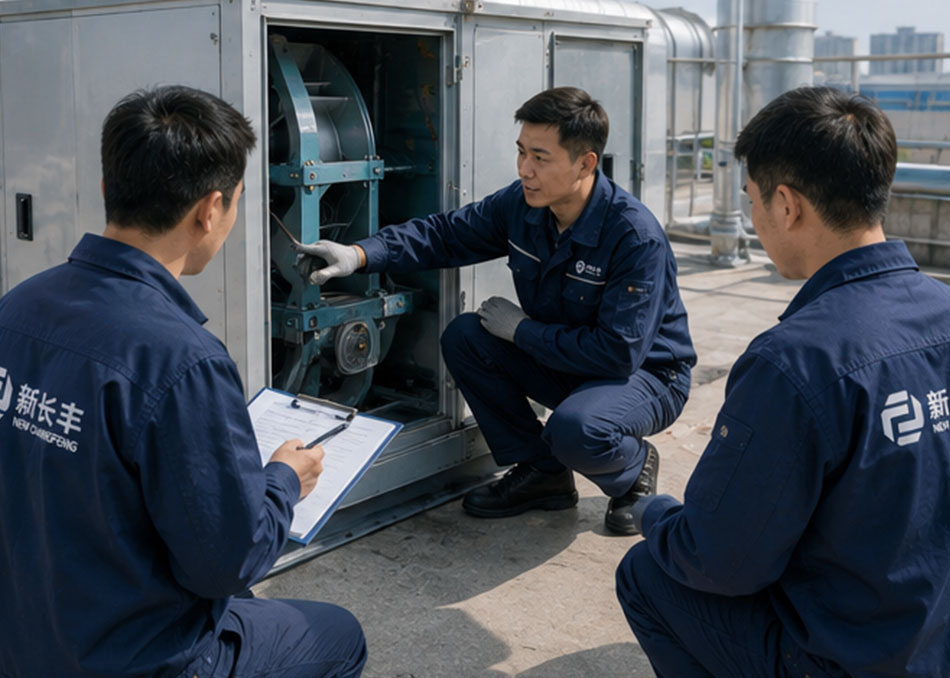
Small restaurants face a familiar squeeze: compact kitchens, tightly clustered cooking stations, and a lunch rush that piles fume, heat and noise on top of each other. Owners need to extract grease-laden smoke cleanly, pass environmental and fire-safety inspections, stay within a tight equipment budget, and avoid noise complaints from neighbors. That is why so many operators search for kitchen water-cooled fresh air unit pricing before they buy anything. But the quote itself is only the surface. What actually determines whether a small kitchen works is how exhaust and make-up air are balanced, what role the axial fan plays in that system, and what the water-cooled fresh air unit is really solving.
Why Small Restaurant Kitchens Fail at Exhaust: Extraction Without Make-Up Air
Under GB 18483, the national emission standard for cooking fume, restaurant exhaust must be purified before discharge. GB 51251, the technical standard for building smoke control and exhaust systems, sets out how ventilation systems should be organized as a whole. In practice, most weak exhaust in small restaurants is not the purifier's fault. The kitchen is simply running in negative pressure because air is being pulled out with nothing coming back in. Flames lean toward the hood, exhaust volume drops, fume spills into the dining room, and drain odors back up through the floor.
The typical small-restaurant situation is few burners, tight floor space, short duct runs, and limited options for cutting through an exterior wall or roof. Make-up equipment therefore should not be oversized or heavy. The goal is matched airflow, low noise and a footprint that fits a cramped back-of-house. This is where axial fans earn their place: their straight-through airflow pattern suits short, direct duct routes, and their compact form factor fits wall or roof openings that a larger centrifugal unit could not use.
The Role of Axial Fans in Kitchen Exhaust and Make-Up Air
An axial fan moves air along the axis of rotation, pulling air straight through the impeller. That design gives high airflow in a small, lightweight package, which is exactly what a small kitchen's make-up or short exhaust run needs. In a typical configuration, the axial fan supplies make-up air near the cooking line or boosts exhaust along a short duct, while a centrifugal fan or purifier handles the higher-static-pressure work of pushing air through filters and long runs.
Matching the fan to the system matters more than the fan's headline airflow. A unit selected purely on maximum airflow can stall against filter resistance, run loudly, or overload its motor. Selection should follow GB/T 1236 fan performance testing data and consider GB 19761 fan energy efficiency grades, so the operating point sits in an efficient range rather than at the edge of the curve. For a small restaurant, a correctly sized axial fan running quietly at its design point will outperform a larger unit throttled down.
- Short, direct runs: axial fans suit straight wall or roof exhaust with minimal bends.
- Make-up air supply: a dedicated axial supply fan relieves negative pressure without a bulky unit.
- Low-noise operation: proper sizing and vibration isolation reduce the noise that triggers neighbor complaints.
- Energy efficiency: check GB 19761 efficiency grades when comparing models.
Where the Water-Cooled Fresh Air Unit Fits
Extraction and make-up air alone do not solve heat. A small kitchen with burners running through service can become unbearable, and pulling in hot outdoor air only makes it worse. A water-cooled fresh air unit conditions the incoming make-up air, lowering its temperature before it reaches the cooking line. That reduces the heat load on the kitchen and improves working conditions without adding a full air-conditioning system.
The unit works best as part of a balanced system: the exhaust side captures and purifies fume, the axial fan supplies tempered make-up air, and the water-cooled unit cools that air. When these elements are sized together, the kitchen stays slightly negative relative to the dining area—enough to contain odors—without the severe negative pressure that starves the exhaust and pulls flames off the burners.
How Kitchen Water-Cooled Fresh Air Unit Quotes Are Built
A quote for a small restaurant is not a single number for a single box. It reflects the exhaust airflow required by the cooking line, the make-up air needed to balance it, the purification stage, duct length and routing, and the noise constraints of the site. Two kitchens with the same number of burners can need very different systems if one vents through a short wall run and the other through a long roof duct.
When comparing quotes, ask what each line item covers: fan model and efficiency grade, purifier type, water-cooled unit capacity, ductwork, installation and commissioning. A low quote that omits make-up air or undersizes the fan often costs more later in failed inspections, complaints and rework. A transparent quote shows the design basis, not just the price.
Frequently Asked Questions
Q: Can a small restaurant use an axial fan for the main exhaust?
A: It can work for short, direct duct runs with low resistance. Where the exhaust must pass through a purifier and a long duct, a centrifugal fan is usually the better choice because it handles higher static pressure. Many kitchens combine the two: axial for make-up air, centrifugal for the purifier run.
Q: Why does my kitchen exhaust feel weak even with a powerful fan?
A: The kitchen is likely in negative pressure. Without make-up air, the fan has nothing to pull and the exhaust volume collapses. Adding a properly sized make-up air fan, ideally with a water-cooled fresh air unit, restores balance and improves capture at the hood.
Q: How do I keep noise from bothering neighbors?
A: Select the fan at its efficient operating point rather than at maximum, use vibration isolation, and route discharge away from nearby windows. Correct sizing is usually more effective than adding silencers after the fact.
Q: What standards should a quote reference?
A: Look for GB 18483 for fume emission, GB 51251 for smoke and exhaust system design, GB/T 1236 for fan performance, and GB 19761 for fan energy efficiency. A supplier who can explain how the design meets these is easier to trust.
Small restaurant kitchens succeed or fail on balance: exhaust that captures fume, make-up air that keeps the kitchen from starving, and cooling that keeps staff working through the rush. Axial fans are a practical, compact part of that system when they are sized to the actual duct resistance and paired with a water-cooled fresh air unit for tempered make-up air. To turn a rough budget into a workable design, share your burner count, duct route and site constraints with a ventilation specialist and ask for a quote that shows the design basis—not just the price.