
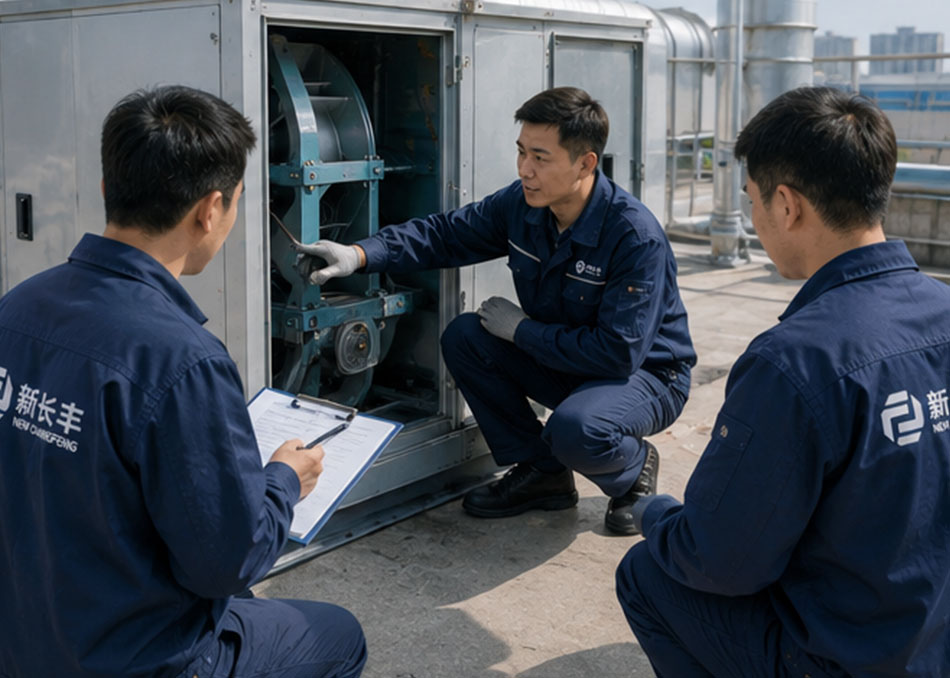
In steel-structure workshops, injection molding shops, metalworking plants, and garment factories, summer heat is a familiar and persistent challenge. Roof panels absorb solar radiation all day, machinery releases substantial process heat, and dense workforces with limited air exchange can push indoor temperatures several degrees above outdoor levels. The result is a workforce that sweats through shifts, productivity that dips, and turnover that climbs. Plant managers face the same question every year: how do you cool a large, semi-open industrial space without burning through your energy budget?
Traditional approaches fall into two camps. Mechanical ventilation — big ceiling fans and axial flow fans — moves air but does not actually lower its temperature; it just pushes hot air around. Compressed-refrigeration air conditioning does cool the air, but in a tall workshop with frequent door openings and high internal heat loads, the cold air escapes almost as fast as it is produced. Electricity bills skyrocket, and many facilities find they simply cannot afford to run conventional AC at the scale their space requires.
This is where the evaporative air cooler (also called a swamp cooler or water-cooled air conditioner) has become a mainstream solution for factory cooling. It uses the physics of water evaporation to reduce air temperature while delivering high air volume and ventilation. Energy consumption is a fraction of that of compressor-based systems, making it particularly well-suited to large, semi-open industrial buildings.
How Evaporative Air Coolers Work — and When They Make Sense
The core principle is evaporative cooling. Hot outdoor air is drawn through a wetted honeycomb cooling pad. As water evaporates, it absorbs a large amount of heat from the air, lowering the air temperature before a fan delivers it into the workspace. This is essentially an adiabatic humidification and cooling process: the air's enthalpy stays roughly constant while its dry-bulb temperature drops and its moisture content rises.
Because the cooling effect depends on evaporation, performance is closely tied to ambient humidity. In dry or moderately humid climates, the temperature drop can be substantial. In very humid conditions, the cooling effect diminishes — but the system still provides powerful ventilation, which many workshops need regardless. This is a key distinction from compressor-based AC: an evaporative cooler always delivers fresh air exchange, not just recirculated cooling.
Evaporative air coolers are a strong fit for:
- Large, open or semi-open industrial spaces where ducted AC would lose most of its cooling to infiltration
- Facilities with high heat loads from machinery or processes
- Operations where ventilation and air exchange are as important as temperature reduction
- Sites looking to reduce cooling energy consumption compared with compressor-based systems
They are less suited to enclosed, humidity-sensitive environments such as cleanrooms, pharmaceutical production, or spaces with strict temperature and humidity tolerances. In those cases, a hybrid approach — evaporative cooling for ventilation and pre-cooling, with targeted compressor-based AC for critical zones — often makes more sense.
Key Selection Factors for Factory Cooling Projects
Choosing the right evaporative air cooler is not simply a matter of matching a catalog number to a square footage figure. Several interdependent factors determine whether the system will actually perform in a real workshop environment.
Air volume and air changes per hour. Industrial cooling is as much about air exchange as it is about temperature. The system must move enough air to displace the hot, stale air in the space and replace it with cooler incoming air. Air changes per hour (ACH) is a useful planning metric: the total volume of the space divided by the air volume the system can deliver per hour. High-heat workshops typically require more air changes than light assembly areas. Because actual performance depends on duct design, static pressure, and installation layout, the fan's rated air volume should always be evaluated against the system's total resistance — this is where GB/T 1236 fan performance testing standards provide a reliable reference for comparing equipment.
Cooling pad efficiency and maintenance. The cooling pad is the heart of the evaporative process. Pad thickness, surface area, and water distribution uniformity all affect how much temperature drop the unit can achieve. Equally important is maintenance: pads that dry out, scale up, or grow algae will lose efficiency quickly. Look for units with accessible pad frames and water systems that are easy to clean and inspect. In dusty factories, pre-filtration or more frequent cleaning schedules may be necessary.
Air distribution and installation position. Where the cool air enters and how it travels through the space determines whether workers actually feel the benefit. Options include direct discharge into work zones, ducted distribution, or a combination of both. In tall workshops, directing cool air to occupied levels — rather than trying to cool the entire volume — is often more effective and energy-efficient. Units can be mounted on walls, roofs, or ground-level pads, depending on the building layout and available space.
Energy efficiency and operating cost. Evaporative air coolers consume significantly less electricity than compressor-based systems because they do not run a refrigeration cycle. However, fan efficiency still matters, especially in larger installations. GB 19761, the Chinese national standard for fan energy efficiency, provides a framework for evaluating fan performance. When comparing options, consider not just the unit's power rating but the air volume delivered per unit of energy consumed, and how that performance holds up under real static pressure conditions.
Noise levels. In workshops where communication or concentration matters, fan noise can become a pain point. Centrifugal fan designs and proper mounting can reduce noise compared with simpler axial configurations. For facilities with noise-sensitive areas, it is worth reviewing sound pressure data and considering acoustic isolation or duct silencers where needed.
Integrating Evaporative Cooling with Other Ventilation Equipment
In many factories, the evaporative air cooler does not work alone. It is part of a broader ventilation and cooling strategy that may include negative pressure fans, axial fans, roof turbo ventilators, and exhaust purification systems. The goal is to create a controlled airflow path: cool air enters through the evaporative cooler, moves through the workspace, absorbs heat and contaminants, and exits through exhaust points.
Negative pressure fans are commonly paired with evaporative coolers to establish this airflow. By continuously extracting air from the space, they help ensure that the cooler's output actually reaches the work zone rather than stagnating. Roof turbo ventilators, which rely on wind and thermal buoyancy, can provide passive exhaust for upper-level heat stratification. In kitchen environments or areas with grease and fumes, kitchen exhaust purifiers and electrostatic fume purification units address air quality separately from temperature control.
For facilities with smoke exhaust requirements, GB 51251 (the Chinese standard for smoke and heat exhaust ventilation systems) sets out design principles that may influence how ventilation equipment is zoned and controlled. While this standard is specific to fire safety, it underscores a broader point: ventilation systems in industrial buildings serve multiple purposes, and cooling equipment should be selected with the entire air management strategy in mind.
Practical Tips for Getting the Most from Your Evaporative Cooling System
Even a well-selected evaporative air cooler will underperform if installation and maintenance are neglected. Here are practical steps that make a measurable difference:
- Match air volume to the space, not just the square footage. Ceiling height, heat load, and occupancy all matter. A high-ceiling workshop with heavy machinery needs more air changes than a warehouse with light activity.
- Control the airflow path. Use exhaust fans or openings to give hot air somewhere to go. Without an exit path, cool air cannot effectively displace the heat.
- Keep water quality in check. Hard water leads to scale; dirty water leads to biological growth. Regular flushing, filtration, and pad cleaning protect both performance and air quality.
- Schedule maintenance before summer. Pads, water pumps, and distribution trays should be inspected and cleaned at the start of the cooling season, not in the middle of a heat wave.
- Consider zone control. In large facilities, running all units at full output may be unnecessary. Zoning allows you to cool occupied areas while reducing output in low-traffic zones.
- Review fan energy efficiency. Fans run for long hours. Selecting models with better efficiency ratings — and ensuring ductwork is not overly restrictive — pays back over the life of the equipment.
Frequently Asked Questions
Q: Can an evaporative air cooler replace traditional air conditioning in a factory?
A: In many large, semi-open industrial spaces, yes — especially where ventilation is as important as temperature reduction. Evaporative coolers deliver high air volume, fresh air exchange, and lower energy consumption. However, in enclosed, humidity-sensitive environments or spaces requiring precise temperature control, they are best used alongside compressor-based systems rather than as a complete replacement.
Q: How much temperature drop can I expect from an evaporative cooler?
A: The achievable temperature drop depends primarily on the ambient wet-bulb temperature, which reflects humidity levels. In drier conditions, the cooling effect is greater; in humid conditions, it is smaller. Rather than relying on a single figure, evaluate performance based on your local climate data and the unit's rated evaporative efficiency. A reputable supplier should be able to help you model expected conditions for your site.
Q: What maintenance does an evaporative air cooler need?
A: Regular maintenance includes cleaning or replacing cooling pads, flushing the water system to prevent scale and algae, checking water distribution uniformity, and inspecting the fan and motor. In dusty environments, more frequent cleaning may be required. Establishing a seasonal maintenance schedule before summer is the most effective way to avoid mid-season breakdowns.
Q: Are evaporative coolers suitable for workshops with high humidity from processes?
A: High process humidity reduces the evaporative cooling effect because the air already holds significant moisture. In these cases, the system still provides valuable ventilation and air movement, but supplementary dehumidification or compressor-based cooling may be needed for effective temperature control. A site assessment is recommended before committing to a design.
Q: How does an evaporative cooler compare with a negative pressure fan for factory cooling?
A: They serve different functions. A negative pressure fan extracts hot, stale air and creates airflow, but it does not lower the incoming air temperature. An evaporative cooler actively cools the air before delivering it. In practice, the two are often used together: the cooler supplies cooled air, and negative pressure fans help ensure that air moves through the workspace and exits efficiently.
Making the Right Choice for Your Facility
Factory cooling is not a one-size-fits-all problem. The right solution depends on your building geometry, process heat load, local climate, workforce density, and budget priorities. Evaporative air coolers have earned their place as a mainstream option for industrial cooling because they address the fundamental mismatch between large, semi-open spaces and the limitations of both simple ventilation and compressor-based air conditioning.
When evaluating equipment, look beyond the headline specifications. Consider fan performance under real static pressure, cooling pad quality and serviceability, air distribution design, and the overall ventilation strategy. These factors determine whether the system will actually deliver comfortable, productive conditions on the hottest days of the year.
For facilities in need of factory cooling, commercial kitchen ventilation, or integrated air management solutions, working with an experienced equipment manufacturer can help ensure that the system is properly sized, installed, and supported. XCFFJ (Shenzhen Xinchangfeng Dust Removal & Cooling Equipment Co., Ltd.) designs and manufactures evaporative air coolers, cabinet centrifugal fans, negative pressure fans, kitchen exhaust purifiers, and related ventilation equipment for industrial and commercial applications. To discuss your project requirements, visit www.xcffj.com or contact the team directly.