
School canteens present a distinctive exhaust challenge that differs from typical commercial kitchens. Multiple cooking stations operate simultaneously, and during peak lunch periods, fume generation spikes sharply within a short window. At the same time, canteens are often located adjacent to teaching buildings or dormitories, meaning excessive fan noise or fugitive oil fumes can quickly trigger complaints. The goal, therefore, is not simply to "push the smoke out" but to balance exhaust volume, purification efficiency, operating noise, and energy consumption.
Under GB 18483 (Emission Standard of Cooking Fume), food service operations must keep oil fume concentrations within specified limits, and purification equipment must meet defined removal efficiency requirements. This means a canteen exhaust system cannot rely on a single fan working in isolation. It must function as a complete chain: capture hood → purifier → fan → discharge point. The fan serves as the power core of this chain, and whether the selected model and its installation are appropriate directly determines whether exhaust flows smoothly and whether fumes escape into the kitchen.
Among the available options, the DT cabinet centrifugal fan is widely used in school canteen exhaust and supply air systems due to its compact structure, relatively high static pressure capability, and controllable noise levels. Negative pressure fans are commonly paired with these systems for general canteen ventilation and heat reduction in the kitchen area. Each plays a distinct role, and their installation methods differ accordingly.
Understanding the DT Cabinet Centrifugal Fan's Role in School Canteen Exhaust
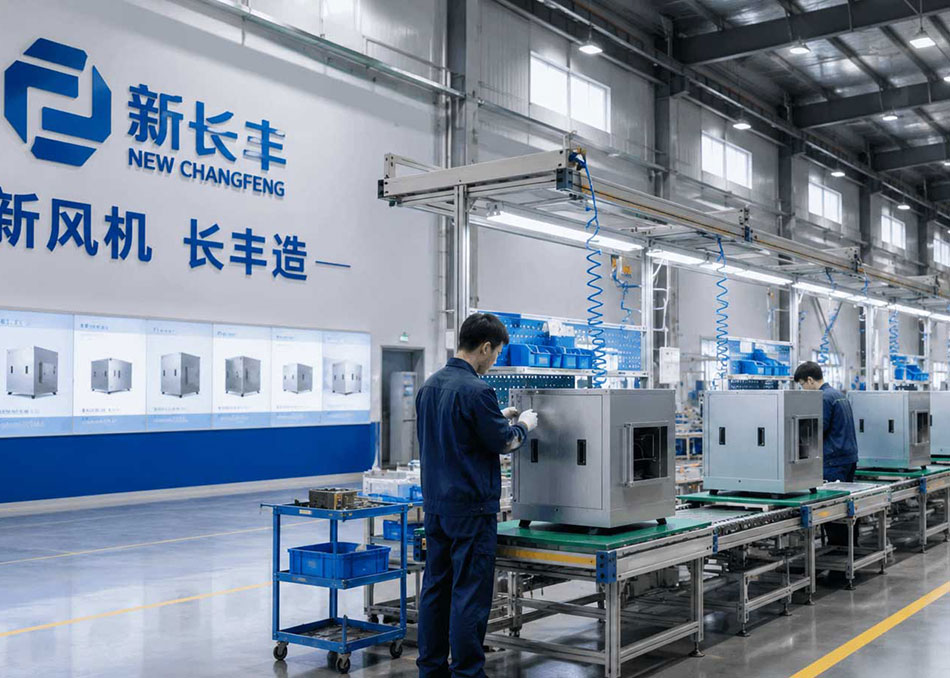
The DT cabinet centrifugal fan is a type of cabinet-style centrifugal ventilator that uses a multi-wing centrifugal impeller. The cabinet typically incorporates sound attenuation or thermal insulation to reduce noise transmission and maintain stable operation. Its working principle is straightforward: air enters through the inlet, is accelerated radially by the rotating impeller, and exits through the outlet with increased pressure. This design allows the fan to overcome the resistance of long duct runs, purification equipment, and discharge fittings — a critical advantage in canteen exhaust systems where the air path is rarely short or straight.
In a school canteen exhaust application, the DT cabinet centrifugal fan is typically positioned downstream of the fume purifier. This placement offers two practical benefits: first, the fan handles air that has already passed through the purification stage, reducing grease accumulation on the impeller and cabinet interior; second, the negative pressure created by the fan draws fumes from the capture hood through the purifier and toward the discharge point, minimizing the risk of leakage at duct joints or equipment connections.
When selecting a DT cabinet centrifugal fan for canteen exhaust, engineers should consider the following factors:
- Exhaust volume requirement: Calculate based on the number of cooking stations, hood dimensions, and the capture velocity needed to contain fumes at the source. GB/T 1236 provides the framework for fan performance testing, and this data should be used to verify that the selected fan can deliver the required airflow under actual system resistance.
- System resistance: Account for pressure losses across the capture hood, ductwork, fume purifier, and discharge outlet. The fan must provide sufficient static pressure to overcome the total resistance at the design airflow.
- Noise control: Since canteens are often near sensitive areas, select a fan with appropriate acoustic treatment and consider additional duct silencers if needed. The cabinet design of DT fans already provides some attenuation, but site-specific assessment is essential.
- Energy efficiency: GB 19761 establishes energy efficiency limits for fans. Choosing a model that meets or exceeds these thresholds helps reduce long-term operating costs, especially in canteens that run exhaust systems for extended hours.
- Grease and moisture resistance: Although the fan is downstream of the purifier, some residual grease and moisture will remain in the airstream. Motors and electrical components should be protected accordingly, and maintenance access should be planned from the outset.
Proper installation of the DT cabinet centrifugal fan is equally important. The fan should be mounted on a level, vibration-isolated base to prevent structural noise transmission. Flexible connectors should be used at both inlet and outlet to absorb vibration and accommodate minor misalignment. Duct connections must be airtight to maintain system pressure and prevent fume leakage. Additionally, the fan should be installed in a location that allows safe access for inspection, cleaning, and impeller maintenance without disrupting canteen operations.
Negative Pressure Fan Installation for Canteen Ventilation and Heat Reduction
While the DT cabinet centrifugal fan handles the exhaust and purification chain, negative pressure fans serve a complementary role: general ventilation and heat removal from the canteen space. In a school canteen kitchen, cooking equipment generates substantial heat, and without adequate air exchange, indoor temperatures can become uncomfortable and working conditions deteriorate. Negative pressure fans work by creating a pressure differential that draws fresh air in through designated openings while expelling hot, stale air through the fan itself.
The installation of negative pressure fans follows a different logic from that of cabinet centrifugal fans. These units are typically mounted on an exterior wall or roof, with their discharge side facing outdoors. The key principle is to ensure a clear, unobstructed path for air to enter the space — through windows, louvered openings, or dedicated fresh air inlets — and then exit through the fan. If the intake path is blocked or undersized, the fan will operate at reduced efficiency and may create excessive negative pressure that interferes with the exhaust system or causes doors to be difficult to open.
When installing negative pressure fans in a school canteen, consider the following practical points:
- Mounting height and location: Install the fan at a height that captures the hottest air, typically near the ceiling or roof level where heat accumulates. Avoid placing it directly above cooking stations where grease-laden air may shorten motor life.
- Intake air path: Ensure that fresh air can enter the space freely. The total effective intake area should be sufficient to match the fan's exhaust capacity. In many canteens, existing windows or vents are adequate, but in enclosed kitchens, dedicated intake louvers may be necessary.
- Structural support and weatherproofing: Exterior-mounted fans must be securely fixed to the wall or roof structure and properly flashed or sealed to prevent water ingress. Consider wind loading and rain protection, especially in coastal or storm-prone regions.
- Electrical safety and controls: Provide dedicated circuits with appropriate protection. If the fan is integrated with the exhaust system, consider interlocking controls so that the negative pressure fan and the DT cabinet centrifugal fan operate in coordination.
- Noise considerations: Negative pressure fans can generate significant noise if not properly selected or mounted. Use vibration isolators, avoid mounting on lightweight panels that resonate, and consider the distance to nearby classrooms or residential buildings.
It is important to note that negative pressure fans and DT cabinet centrifugal fans should not be treated as interchangeable. The former is optimized for moving large volumes of air at relatively low pressure, making it suitable for general ventilation. The latter is designed to generate higher static pressure, which is necessary to overcome the resistance of purification equipment and ductwork in the exhaust chain. Using the wrong type in either role can lead to poor performance, excessive noise, or premature equipment failure.
Integrating the Exhaust Chain: From Capture Hood to Discharge Point
A well-functioning school canteen exhaust system is more than the sum of its parts. The capture hood must be sized and positioned to contain fumes at the source. The fume purifier — whether electrostatic, baffle-type, or a combination — must be matched to the expected fume load and maintenance schedule. The DT cabinet centrifugal fan must provide the airflow and pressure needed to move air through the entire system. And the discharge point must be located away from air intakes, windows, and neighboring buildings to prevent re-entrainment of exhaust air.
In practice, many canteen exhaust problems trace back to a mismatch somewhere in this chain. A fan that is too small will struggle to maintain airflow as filters load with grease, leading to fume escape at the hood. A fan that is too large may create excessive negative pressure, causing doors to slam or drawing conditioned air from adjacent spaces. Similarly, a purifier that is undersized or poorly maintained will allow grease to pass through to the fan and ductwork, increasing fire risk and maintenance costs.
To avoid these issues, the system should be designed as a whole, with each component selected based on the same design airflow and pressure drop calculations. GB 51251 (Standard for Smoke Control and Exhaust Systems in Buildings) provides relevant guidance on exhaust system design, including considerations for fire safety and smoke management that may apply to commercial kitchen exhaust in certain building configurations. While school canteens are not typically classified as high-hazard occupancies, the principles of proper airflow, containment, and safe discharge remain applicable.
Maintenance and Long-Term Reliability
Even the best-designed exhaust system will degrade without regular maintenance. In school canteens, where operating schedules are predictable but usage is intense, establishing a maintenance routine is essential. The DT cabinet centrifugal fan should be inspected periodically for grease buildup on the impeller, vibration, unusual noise, and belt tension (if belt-driven). The negative pressure fan should be checked for free rotation, secure mounting, and unobstructed airflow paths.
The fume purifier requires the most frequent attention. Electrostatic precipitators need regular cleaning of collection plates, and baffle filters must be degreased or replaced according to the manufacturer's recommendations. Ductwork should be inspected for grease accumulation, especially at bends and transitions where deposits are more likely to form. Discharge outlets should be checked to ensure they remain clear and that no obstructions have developed.
Documenting maintenance activities and keeping spare parts on hand — such as filters, belts, and vibration isolators — can reduce downtime and extend equipment life. For school administrators, a well-maintained exhaust system not only ensures compliance with GB 18483 but also contributes to a healthier, more comfortable working environment for canteen staff and a more pleasant dining experience for students.
Frequently Asked Questions
Q: Can a negative pressure fan be used as the main exhaust fan for a school canteen?
A: No. Negative pressure fans are designed for general ventilation and heat removal, not for overcoming the resistance of fume purification equipment and long duct runs. A DT cabinet centrifugal fan or similar high-static-pressure fan is required for the exhaust and purification chain. Using a negative pressure fan in this role would result in insufficient exhaust, fume escape, and potential motor overload.
Q: Where should the DT cabinet centrifugal fan be installed in the exhaust system?
A: The fan is typically installed downstream of the fume purifier and before the discharge point. This arrangement reduces grease accumulation on the fan and allows the fan to draw air through the purifier, minimizing leakage. However, the exact position depends on the system layout, available space, and maintenance access. In some cases, a push-through configuration may be used if the purifier is designed for pressurized operation.
Q: How can I reduce noise from canteen exhaust fans?
A: Noise reduction starts with proper selection — choose a fan with appropriate acoustic treatment and avoid oversizing. Install vibration isolators and flexible duct connectors to prevent structural transmission. Use duct silencers where necessary, and ensure that the fan is mounted on a solid, non-resonant surface. Regular maintenance also helps: a dirty or unbalanced impeller can significantly increase noise levels.
Q: What maintenance does a DT cabinet centrifugal fan require?
A: Routine maintenance includes checking for grease buildup on the impeller and housing, inspecting belts and bearings (if applicable), verifying vibration levels, and ensuring that electrical connections are secure. The fan should be cleaned according to the manufacturer's recommendations, and any signs of imbalance, unusual noise, or reduced performance should be addressed promptly. Keeping the upstream purifier well-maintained will also reduce the cleaning frequency required for the fan.
Q: Does the exhaust system need to meet any specific standards?
A: Yes. In China, GB 18483 sets emission limits for cooking fume, and GB/T 1236 provides the framework for fan performance testing. GB 19761 establishes energy efficiency requirements for fans, and GB 51251 offers guidance on smoke control and exhaust system design. Compliance with these standards helps ensure that the system performs as intended and meets regulatory requirements.
Designing an effective school canteen exhaust system requires careful attention to the entire air path — from capture hood to discharge point — and a clear understanding of how each component contributes to the whole. The DT cabinet centrifugal fan plays a central role, providing the pressure needed to move air through purification equipment and ductwork while maintaining acceptable noise levels. Negative pressure fans complement this system by improving general ventilation and reducing heat buildup in the kitchen. When selected and installed correctly, these components work together to create a safer, more comfortable, and more efficient canteen environment.
For assistance with selecting the right fan for your canteen exhaust project, or to learn more about XCFFJ's range of cabinet centrifugal fans, negative pressure fans, and ventilation solutions, visit www.xcffj.com or contact our technical team directly.