
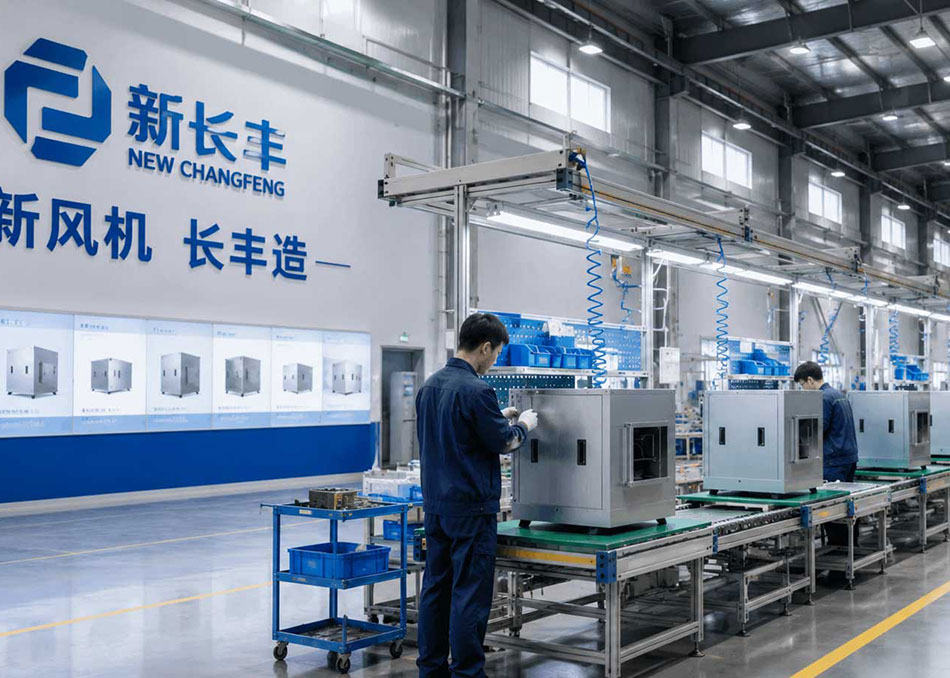
During hot summer months, heat accumulation and stagnant air inside industrial plants rank among the toughest problems for workshop managers. Processes such as welding, casting, injection molding, drying and food processing continuously release heat, and when you add solar radiation on the roof, equipment exhaust and dense occupancy, indoor temperatures often climb above outdoor levels—bringing stuffiness, odors and lingering dust along with them. Many factories also operate a canteen or central kitchen adjacent to the production area, where overlapping heat sources further amplify the overall ventilation load. Designing a equipment combination that reliably expels heat and contaminated air is the core challenge of any plant ventilation and cooling scheme. With their high-volume exhaust and ability to organize airflow, negative pressure fans play the critical "extraction" role in industrial plant ventilation and cooling, and they are a common building block in kitchen cooling support equipment as well.
How Negative Pressure Fans Work and the Logic of Plant Ventilation
A negative pressure fan is essentially a high-volume exhaust device mounted in a wall or window opening. When running, it forces indoor air outdoors, creating a slight negative static pressure relative to the outside. Under this pressure differential, fresh outdoor air is drawn in naturally through opposite doors, windows, louvers or dedicated inlets, forming a directed "in at one end, out at the other" airflow pattern inside the plant. This method—using mechanical exhaust to establish a pressure differential and letting inlet openings complete the air exchange—is what the industry calls negative pressure ventilation.
Compared with simply blowing air using axial fans, the advantage of negative pressure ventilation lies in controllable airflow paths. As long as exhaust points and inlet points are laid out sensibly, fresh air can be made to travel across worker zones and heat-source areas, carrying heat, dust and odors out of the building along the way rather than merely stirring the air around. This is why negative pressure fans are frequently specified together with axial fans, evaporative air coolers and fresh air units in plant cooling projects—each device has a distinct role, and the exhaust side is what makes the whole system work.
From a standards perspective, fan performance should be evaluated according to GB/T 1236 (industrial fan performance testing), while energy efficiency can be referenced against GB 19761 (fan energy efficiency limits and grades). Selecting equipment based on tested performance rather than nominal claims is the foundation of a reliable, energy-conscious design.
Typical Applications in Industrial Plant Cooling
Negative pressure fans suit workshops with high heat loads, large floor areas and multiple natural inlet openings. In welding, casting, injection molding and drying shops, the fans are usually installed on the leeward wall or high on the wall, with inlets arranged on the opposite side or at low level near worker zones. This configuration pushes fresh air across the occupied area before it picks up heat and exits, improving both thermal comfort and air quality.
In food processing plants and factories with attached canteens or central kitchens, the fan often serves as the exhaust backbone of the overall ventilation strategy. Kitchens generate intense sensible heat and grease-laden fumes; the production area next door adds its own heat. Using negative pressure fans to establish a clear exhaust path helps prevent hot, oily air from migrating into production zones, while dedicated kitchen exhaust purifiers handle fume purification in line with GB 18483 (emission standard for cooking fumes). For buildings that also require smoke and heat exhaust provisions, the design should account for GB 51251 (technical standard for smoke and heat exhaust ventilation systems)—negative pressure fans used for daily ventilation are not a substitute for dedicated smoke exhaust systems, and the two must be coordinated at the design stage.
Warehouse logistics facilities and large assembly halls benefit as well: the fans are low-maintenance, tolerate dusty environments and can be combined with roof turbo ventilators to exploit stack effect and further improve air exchange.
Design and Selection Points That Matter
Effective negative pressure ventilation depends far more on layout than on buying the biggest fan available. The first step is to calculate the required air change rate based on heat load, occupancy and process emissions, then match fan count and capacity to the building volume and the available inlet area. If the inlet area is too small, the pressure differential grows but airflow drops, and the fans end up working against themselves.
- Airflow path first: Map where fresh air enters and where hot, contaminated air exits; make sure the path crosses worker zones and heat sources.
- Adequate inlet area: Provide sufficient doors, louvers or purpose-built inlets—undersized inlets are the most common cause of poor results.
- Fan placement: Install exhaust fans high on the leeward wall where possible, avoiding short-circuiting between inlet and exhaust.
- Noise and maintenance: Consider noise sensitivity of neighboring areas and choose models with accessible belts, bearings and shutters for routine service.
- System integration: Combine negative pressure exhaust with evaporative cooling or fresh air units for a complete "extract plus supply" strategy rather than relying on exhaust alone.
Because actual performance varies with installation, ducting and shutter conditions, selection should be based on verified performance data and site survey results rather than rule-of-thumb figures alone.
Common Pitfalls and How to Avoid Them
One frequent mistake is treating negative pressure fans as standalone cooling devices. They remove heat; they do not refrigerate air. In very hot, dry climates, pairing exhaust fans with evaporative air coolers or water-cooled fresh air units delivers far better results than exhaust alone. Another pitfall is ignoring the kitchen: when a canteen sits next to the workshop, kitchen exhaust and plant exhaust compete for the same makeup air, and without coordinated design both areas suffer.
Poor maintenance also erodes performance over time—clogged shutters, slack belts and dust buildup on blades reduce airflow and raise energy consumption. A simple periodic inspection schedule keeps the system performing as designed and supports compliance with energy efficiency requirements.
FAQ
Q: Can a negative pressure fan lower the workshop temperature on its own?
A: It removes hot air and brings in cooler outdoor air, which improves comfort when outdoor temperatures are lower than indoor temperatures. In peak summer heat, it is best combined with evaporative cooling or fresh air units for a more noticeable cooling effect.
Q: How much inlet area does a negative pressure fan need?
A: Inlet area should be sized in proportion to exhaust airflow so the pressure differential stays within the fan's working range. As a practical rule, ensure generous openings opposite the fans and avoid blocking them with stored goods or equipment; a qualified ventilation designer can calculate the exact requirement for your building.
Q: Are negative pressure fans suitable for kitchens and canteens?
A: They are commonly used as part of kitchen exhaust and cooling support systems, but grease-laden fumes should be handled by dedicated kitchen exhaust purifiers to meet GB 18483 requirements. Negative pressure fans work best as the general exhaust backbone, coordinated with purification equipment.
Q: What standards should I reference when selecting fans?
A: Look for performance data consistent with GB/T 1236 testing and check energy efficiency against GB 19761. For buildings with smoke exhaust requirements, coordinate with GB 51251 at the design stage.
Getting plant ventilation right is a system exercise: understand the heat sources, design the airflow path, and let each device do its job. Negative pressure fans are the workhorse of the exhaust side—reliable, straightforward to maintain and effective when properly applied. To discuss a ventilation and cooling layout for your factory, canteen or warehouse, contact XCFFJ (Shenzhen Xinchangfeng Dust Removal & Cooling Equipment Co., Ltd.) at www.xcffj.com for product information and application guidance.